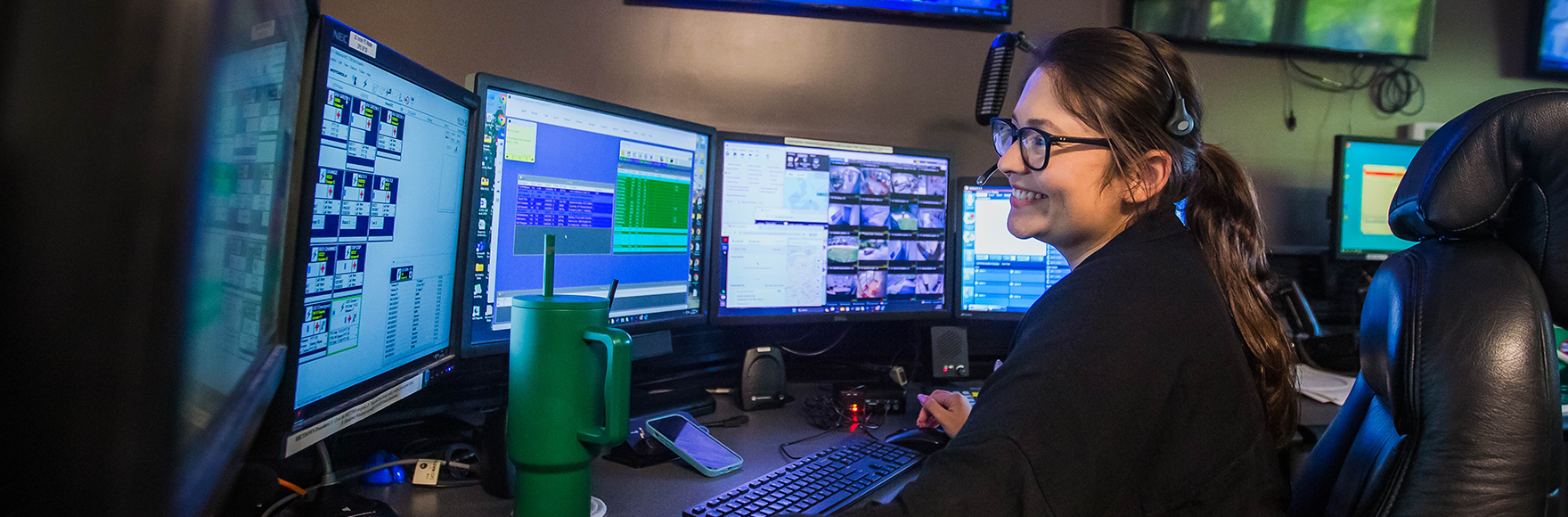
Public Safety Dispatcher
Make an Impact from the Communications Center
A university never really “slows down,” and the communications center is where it all connects.
As a University Public Safety Dispatcher, you’ll be the calm, clear voice behind emergency and non-emergency calls—asking the right questions, capturing critical details, and coordinating help quickly.
What makes campus dispatch different is the environment you support. Many of your callers will be students navigating a stressful situation for the first time, as well as parents, visitors, and staff who may not know where they are or who to call. Your ability to listen, reassure, and set the tone is just as important as speed.
You’ll also support a campus rhythm that changes by the hour. From athletics games and concerts to move-in/move-out and commencement, events can quickly shift call volume, staffing needs, and priorities—and you help keep communication steady when the pace picks up.
And you won’t be coordinating only police officers. University response often involves a wider team—campus support roles, housing partners, event staff, and other resources—so you’ll be the connector who helps the right people get to the right place at the right time. If you’re steady under pressure, strong at communication and customer service, and you want meaningful work that’s different every day, you’ll bring peace of mind to the campus community—every shift.

Work Environment & Schedule
- You’ll work a consistent shift for 4 months before it rotates.
- Shifts typically change three times a year—in January, May, and September.
- Most weeks, you’ll work four 10-hour days and have three days off.
Position Overview
- Serve as the primary connection between the campus and medical center communities and responding officers/field units when help is needed.
- Answer and prioritize requests for help (including 9-1-1 and other emergency lines), quickly assessing the situation and determining needed resources.
- Monitor and respond to campus emergency systems (blue light call boxes, elevator phones), escalating issues and coordinating follow-up as needed.
- Coordinate campus operations support—Housing, Transportation, Facilities, and EH&S—to resolve incidents and service needs quickly.
- Coordinate public safety response with officers, hospital security, fire, and neighboring law enforcement as needed.
- Support large-scale campus events and athletic games by coordinating staffing, communications, and rapid response across multiple teams.
- Track incidents and maintain accurate records by entering, updating, and retrieving information in dispatch and law-enforcement databases (including CLETS/NLETS and other systems).
- Provide timely research and information to field personnel to support decision-making during active calls for service.
- Monitor communications center systems (alarms, phone/radio equipment), report technical issues, and maintain situational awareness.
- Use strong communication and judgment to help de-escalate situations and support callers during high-stress incidents, including medical and mental-health related calls.
- Monitor campus cameras when needed to assist with awareness and response coordination.
- Operate in a 24/7 communications center environment, supporting continuous public safety coverage for the university and medical center.
Required Qualifications
- High school diploma or equivalent
- Typing speed: at least 35 WPM
- Strong communication skills: clear, professional oral and written communication with a wide range of callers
- Customer-service mindset: courteous, respectful, and helpful under pressure
- Accuracy and attention to detail
- Sound judgment and ability to make good decisions in fast-moving situations
- Ability to prioritize and multitask during heavy workload and frequent interruptions
- Calm under pressure: maintain composure and relay complete, accurate information during emergencies
- Problem-solving skills: analyze situations and resolve complex issues in a structured, demanding environment
- Comfort with technology: work in a multi-screen, real-time computer environment with minimal errors
- Computer skills: proficiency with Windows and Microsoft Word/Excel
- Ability to learn: complex public safety procedures, radio/phone protocols, and applicable laws/regulations
- Radio/telephone skills: ability to effectively receive and transmit information
- Local knowledge: ability to learn campus/medical center geography and read/interpret maps
- Teamwork: build and maintain strong working relationships with supervisors, coworkers, and department staff
- Reliability: maintain good attendance and dependability
- Scheduling flexibility: ability to work rotating shifts (days, nights, weekends, and holidays); during training, ability to rotate with training officers on short notice
- Background clearance: ability to successfully pass a law-enforcement level background check
- Driver’s license: valid California driver license and ability to participate in the DMV Employer Pull Notice (EPN) program
Preferred Qualifications
- Computer-Aided Dispatch (CAD) experience
- Familiarity with campus and medical center locations
- California POST Basic Dispatch Academy certificate
- Knowledge of Orange County radio codes and the phonetic alphabet
Hiring Process
- Applications Accepted
- Written Examination
- Panel Interview
- Background Investigation
- Background Review
- Conditional Job Offer
- Medical Examination
- Psychological Examination
- Final Job Offer